Sattubhatta Jataka
Sattubhatta Jataka
Long ago, in a time when gods and humans walked more closely, the great Bodhisatta was born as a wise and benevolent brahmin named Sattubhatta. He lived in a small village near the Himalayas, a place of serene beauty where the air was crisp and the scent of pine needles filled the breeze. Sattubhatta was not like other brahmins who sought power or prestige. He found his joy in the simple act of cultivating the land, tending to his small patch of earth with diligence and care. His harvests were always bountiful, not through magic, but through his deep understanding of the soil, the seasons, and the needs of the plants. He shared his produce generously with the villagers, ensuring that no one went hungry.
In the same region, there lived a king named Supparaka, a ruler whose heart was not as fertile as Sattubhatta’s fields. King Supparaka was a man of immense power, but his reign was marked by greed and a relentless desire for more. He was particularly obsessed with acquiring rare and precious jewels, believing that the more he possessed, the greater his glory would be. His treasury overflowed with diamonds, rubies, and sapphires, yet his heart remained empty, forever yearning for the next glittering prize.
One day, news of Sattubhatta’s exceptional skill in agriculture reached the king’s ears. It was said that Sattubhatta could coax life from the most stubborn soil and that his grains were the sweetest, his fruits the most succulent in all the land. King Supparaka, ever eager to add to his collection of valuable things, devised a plan. He sent for Sattubhatta, intending to claim his land and his produce for the royal treasury.
When Sattubhatta arrived at the king’s grand palace, a structure of marble and gold that seemed to scrape the sky, he was met not with warmth, but with a cold, appraising gaze from the king. “Brahmin Sattubhatta,” King Supparaka began, his voice resonating with authority, “I have heard of your remarkable harvests. It is said that your land yields wonders unseen elsewhere. I decree that from this day forth, all that you grow shall belong to me, the King. Your fields will be a royal garden, and your labor will enrich my treasury.”
Sattubhatta, though taken aback by the king’s decree, remained calm. His face, weathered by sun and wind, showed no fear, only a quiet dignity. “Your Majesty,” he replied respectfully, “I am but a humble cultivator. My skill, if it can be called that, comes from diligent work and the blessings of nature. I share my bounty freely with my community, for that is the true purpose of abundance.”
“Purpose?” the king scoffed. “The purpose of abundance is to serve the glory of the king! Your sentimentality is misplaced. You will work my lands, and all that you produce will be brought to my palace. Failure to comply will result in dire consequences.”
Sattubhatta bowed his head. He knew he could not fight the king’s power, but he also knew he could not abandon his principles. He returned to his village, his heart heavy, but his resolve firm. He continued to cultivate his land, but now, every grain, every fruit, every vegetable was carefully set aside and transported to the royal palace, a long and arduous journey.
The royal granaries began to fill. The palace kitchens were stocked with the finest produce. Yet, King Supparaka was not satisfied. The more he received, the more he wanted. His greed was insatiable. He demanded more, faster, better. The villagers, deprived of Sattubhatta’s usual generosity, began to suffer. Their faces grew gaunt, and their spirits began to wane.
Sattubhatta observed this with deep sorrow. He saw the king’s obsession with material wealth destroying the well-being of his people. One day, a delegation of villagers, their eyes pleading, approached him. “Wise Sattubhatta,” they implored, “the king takes all. We have nothing left. Our children cry from hunger. What can we do?”
Sattubhatta looked at the suffering faces, and a profound sadness filled him. He knew he had to act, not with force, but with wisdom. He decided to teach the king a lesson, a lesson about the true nature of wealth.
He gathered the finest grains, the sweetest fruits, and the most succulent vegetables from his fields. He prepared a simple, yet exquisite meal. Then, he traveled back to the palace, carrying his offering. This time, however, he did not simply hand over the produce. He requested an audience with the king, not to deliver tribute, but to share a meal.
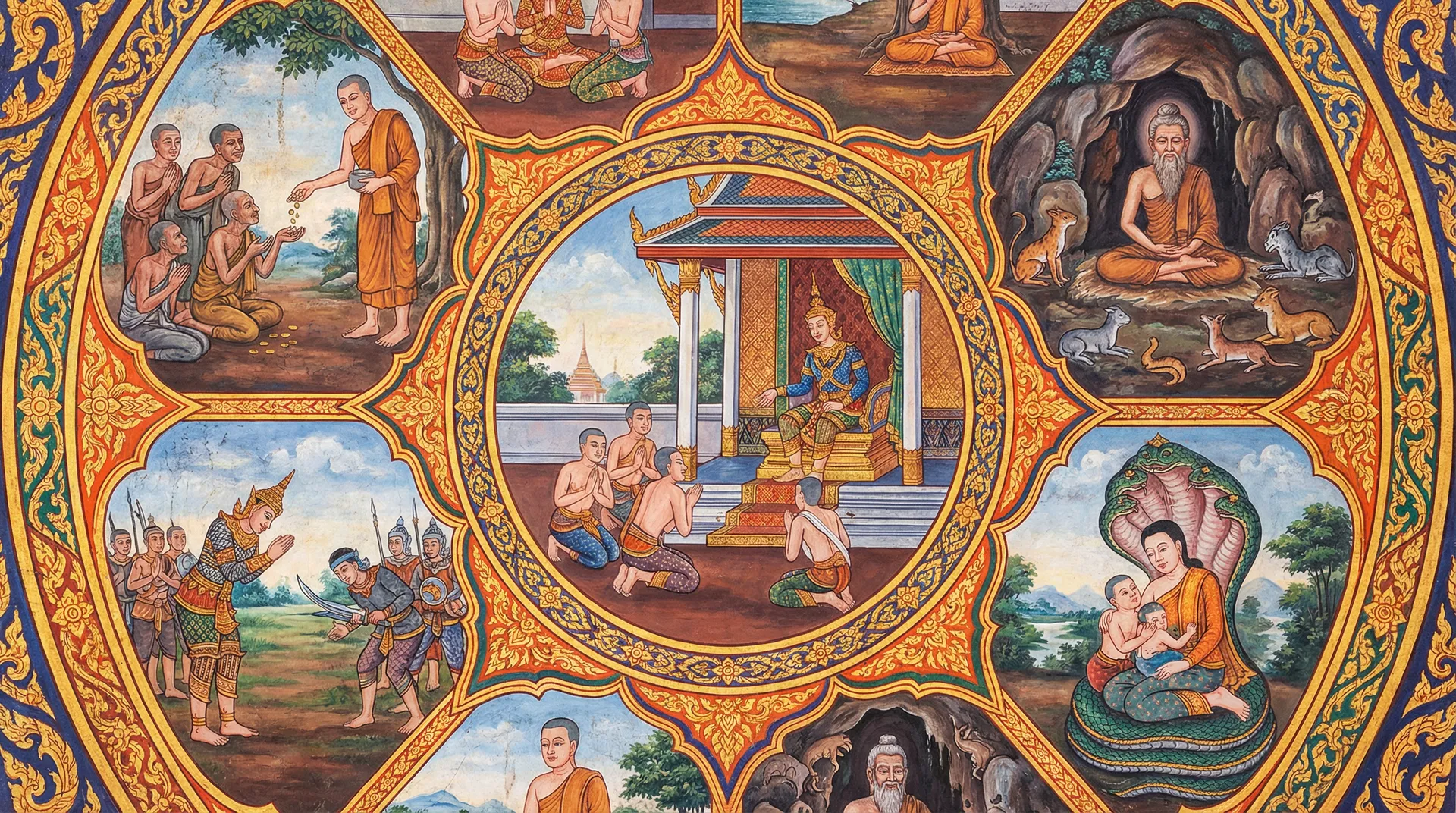
King Supparaka, intrigued by this unusual request, granted it. Sattubhatta was led into the royal dining hall, a place of unimaginable luxury. The king sat on his jeweled throne, surrounded by courtiers adorned in silks and gems. Sattubhatta, in his simple robes, placed his offering before the king.
“Your Majesty,” Sattubhatta said, his voice clear and resonant, “I have brought you the fruits of my labor. But I do not offer them as tribute. I offer them as a gift, for you to share with those who truly need it. For true wealth is not in hoarding, but in giving. True satisfaction comes not from possessing, but from nourishing.”
He then began to serve the food, not to the king first, but to the lowest servants in the hall, the guards, the cooks, the stable hands. He gave them generous portions, speaking words of gratitude and encouragement. Then, he offered food to the courtiers, and finally, he presented a small portion to the king.
King Supparaka watched in stunned silence. His greedy heart, accustomed to receiving, was bewildered by this act of selfless distribution. He saw the genuine joy on the faces of those who received the food, a joy far more radiant than any jewel in his crown.
As Sattubhatta served the last of the meal, he looked directly at the king. “Your Majesty,” he said, “you possess treasures beyond measure, yet your heart is poor. You have jewels that sparkle, but you lack the true jewels of compassion and generosity. This food, though simple, is a treasure because it nourishes the body and lifts the spirit. Hoarded wealth becomes a burden, but shared abundance becomes a blessing.”
The king remained silent for a long moment. The simple words of the brahmin, delivered with such quiet conviction, struck a chord deep within him. He looked at his overflowing coffers, at the endless piles of glittering stones, and for the first time, he saw them not as symbols of power, but as useless burdens. He looked at the smiling faces of his servants, their hunger appeased by Sattubhatta’s humble offering, and he felt a pang of shame.
Slowly, King Supparaka rose from his throne. He walked over to Sattubhatta and bowed his head. “Wise Sattubhatta,” he said, his voice filled with emotion, “you have shown me a truth more precious than any diamond. My wealth has made me a prisoner of my own greed. Today, I see the emptiness of my obsession.”
From that day forward, King Supparaka changed his ways. He ordered his granaries to be opened, and his vast stores of grain were distributed to the needy. He established charitable institutions and ensured that his people were well-fed and cared for. He still valued jewels, but he no longer let them rule his heart. He learned that the true measure of a king’s wealth was not in what he possessed, but in the well-being and happiness of his subjects.
Sattubhatta returned to his village, his heart light. He continued to till his land, not for a greedy king, but for the joy of cultivation and the well-being of his community. The land flourished, the villagers prospered, and the legend of the wise brahmin who taught a king the true meaning of wealth spread throughout the land, a testament to the power of generosity and the wisdom of a contented heart.
— In-Article Ad —
💡Moral of the Story
True wealth is not measured by possessions, but by generosity and the well-being of others. Greed leads to emptiness, while sharing brings true satisfaction and prosperity.
Perfection: Generosity (Dana Paramita), Wisdom (Panna Paramita)
— Ad Space (728x90) —
More Jataka Tales You May Enjoy
352PañcakanipātaKusa Jataka
Kusa Jataka Long, long ago, in the ancient kingdom of Mithila, there lived a prince named Kusa. He w...
💡 True love and unwavering resolve can overcome great obstacles, and wisdom is often gained through hardship and self-reflection.
 176Dukanipāta
Mahāsuka Jātaka
Mahāsuka JātakaIn the ancient city of Mithila, nestled amidst lush gardens and bustling marketplaces...
💡 True happiness is not found in external possessions or fleeting pleasures, but in the cultivation of inner peace, wisdom, and virtue. The greatest treasure is the joy of a contented mind, free from the bondage of insatiable desires.
 100Ekanipāta
The Tale of Timpinnaka
In a time long past, when the Bodhisattva was yet a divine being, in this very existence he was rebo...
💡 True prosperity comes from a pure heart and selfless actions. Greed leads to destruction, while compassion and generosity create lasting blessings.
60EkanipātaThe Tale of Ukkuthita
In the prosperous city of Savatthi, during an age long past, there lived a merchant named Ukkuthita....
💡 True skill and mastery are born from diligent practice and self-reliance, not from exploiting external circumstances or relying on deception.
34EkanipātaThe King Unattached to Glory
The King Unattached to Glory In the ancient land of Benares, where the sun cast a golden hue upon s...
💡 Honesty and integrity are the noblest virtues. Even small matters should not be overlooked. Deceiving others will lead to severe consequences.
236DukanipātaMugapakkha Jataka
Mugapakkha JatakaIn the ancient kingdom of Mithila, nestled beside the shimmering Gandaki River, liv...
💡 True wisdom and effective communication can manifest in many forms, not just through speech. Inner silence can cultivate profound understanding and strength.
— Multiplex Ad —